Tuesday, 9 June 2020

Sad family tale

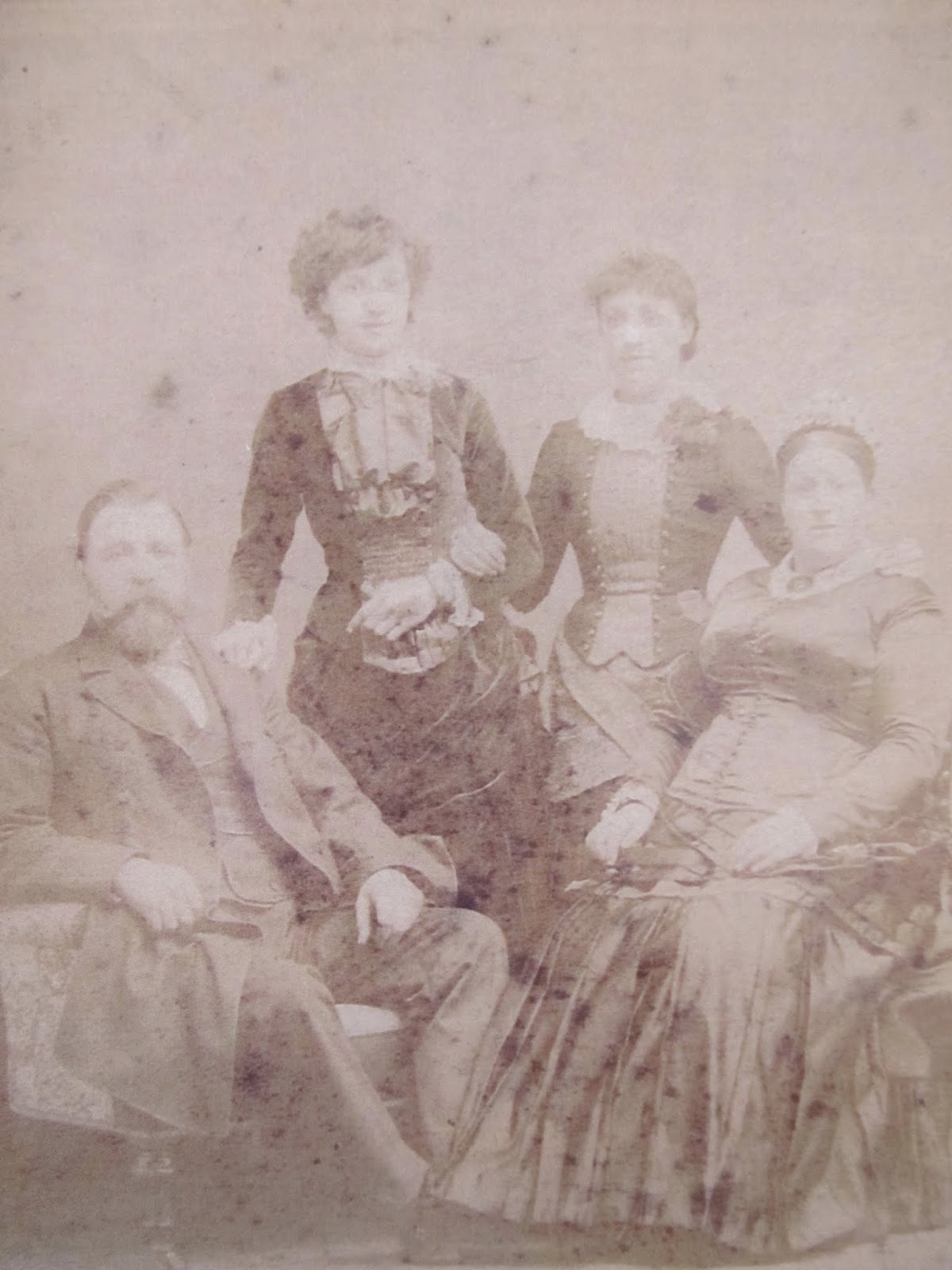
I have come to a place when I can finally tell a story. It is the story of my great grandmother's sister Jane Ann, or Jenny.

When my dad died, I took on the mantle of family researcher. Dad was a natural historian and story teller, and perhaps if the world had been different for him, he could have written down the stories. But instead he collated lots of photos and documents meticulously in folders, and we worked together on mysteries of the family tree, me in one country, him in another.

He periodically mentioned Jenny and her two sons, Charles and Arthur, whom he could not get any further information for beyond the last available Census of 1911.

So after Dad died, I found myself digging, in his memory. What happened to them, and was I genuinely the last of this family line, being an only child with no children of my own?

Like many who investigate their long deceased relatives, information often comes in waves, sometimes a piece of flotsam on the beach leads to revelations of joy and sorrow. In Jenny's case, it was mostly the latter.

Through a group of genealogists on Facebook who gave their experienced help gratis, I discovered that Jenny had four daughters in addition to Charles and Arthur (Dad didn't know this). Three had been born and died between the Censuses. Almost by accident I uncovered a census entry for the second daughter, living far away from either her mother or father's family. It transpired that she had been put into the care of Barnados foster families for several years then returned to her father. In the final official information about her, she was living in a mental hospital during WW2. Tragically, this was also the fate of Arthur, her older brother.

This week through wild card searches on the web I discovered that the first girl born in the family had died in a freak accident before her first birthday, being smothered by her own bedclothes. The youngest two daughters died age 2 and 3 after the widowed father returned to the E. End of London immediately after Jenny's death.

Jenny died of consumption aged 38. Her sister, my great grandma had nursed her. I have her death certificate, which had been kept safely with all our family papers. I remember my dad telling me that Jenny and my great grandmother were very close. Their older brother and sister were lost to illness, a burden that many Victorian families bore due to devastating and deadly childhood diseases. My great grandma had lost her firstborn twins and my grandfather was her only child. Then she lost her sister. To my knowledge and my dad's knowledge she never saw her nephews and nieces again. I doubt she knew that the children suffered terribly as their father had a breakdown and turned to drink after his wife's death. So that left me trying to trace Charles. He was last mentioned during World War 2 as a bus conductor and his wife was working making radios for the war effort. I think I found a record of their daughter, and her three sons, who are are of my generation. But here the road stops. There are no more signposts, just lots of dead ends.

This branch of my family has caused many tears for me - a sense of loss, and grieving for lives that were so hard. Arthur and his sister lived to ripe old age, but we didn't know that. If my father had known, he would have visited them. Family was family. If my great grandmother had known the fate of her nephews and nieces, I think she would have tried to adopt them. She only had one child and she and my great grandfather were modestly prosperous. It could have ended very differently. I just hope the grandchildren and great grandchildren of Charles will somehow carry some of the love and grace of their ancestor Jenny.


Saturday, 9 May 2020

TS Eliot and Lockdown

April is the cruelest month, breeding lilacs out of the dead land, mixing memory and desire...

As a teenager I found Eliot's poetry weird. I didn't understand it or like it. If that makes me a peasant in the eyes of many, I don't care. But this opening to The Wasteland has reverberated since Lockdown. Our extraordinary "halt", standing on a planet that still spins whilst we don't has certainly mixed memory with desire. All the things which only two months ago we could have are now a memory. The spontaneity of showing up at a friends door, laughing with strangers sitting at the adjacent cafe table, the monotony of the weekly grocery shop, planning a road trip to the next city. All gone.

I love being at home. I never run out of things to do and I'm quite happy with my own company if my husband is closeted away writing. But sometimes it is really hard to smell the lilacs, knowing that there are many millions barely surviving.

The Biblical book of Lamentations opens with "How lonely sits the city that was full of people!" The prophet talks of Jerusalem, but his exclamation could rattle and echo around every city in the world right now. I am longing for the muted hum of people against the stones and the walls of my small town again, not the echoing crack of just one footfall. The loneliness of the inanimate is palpable.

And the future lilacs, where shall we find them? I remember a lilac bush in our garden when I was a small child. At certain hours of the day, I could smell its fragrance through my bedroom window. It would catch me by surprise and then its intensity would grow until everywhere I went in the house I could smell it. I am grasping for that intensity now. I want the fruit of this experience to bring something so intense to my life that it changes everything that remains of it for the better.

I am looking for lilacs.


Tuesday, 21 April 2020

Channeling my great grandfather

Yesterday we saw a small flock of sheep run past our garden gate. They were on a mission, but being sheep, had forgotten what it was.


I phoned a neighbour who told us later they had been captured and their wooly bottoms had scuttled reluctantly home.

This morning, on a rare walk towards our hills, I was almost knocked over by the same flock, skipping down the 'long acre' looking for clover.

Thankfully another neighbour happened to be walking in the opposite direction. She had been the one who had got them into a paddock yesterday. Between us we gathered them up. She ran ahead and opened the gate on a neighbours field. I got behind them and ran them to the right side of the road. They stopped abruptly and started to graze. Then another neighbouring farmer's dogs started to bark which was enough to get the wooly bums hopping through the gate and be secured, until next time.

I had to smile. I have been doing family history research for 6 years, picking up the mantle of my late father. We're an ordinary bunch, no skeletons in cupboards, no hidden aristocrats (at least on my dad's side). We used to joke that we came from a long line of shepherds and sheep rustlers.

I rest my case.


Saturday, 7 March 2020

The bungalow on the corner

My dad was a man of many talents. He was a trained toolmaker and spent his working life controlling a massive lathe, making very intricate pieces of machinery. He started with severe osteoarthritis in his 40s, partly the product of standing on cold concrete floors in draughty factories and shipyards.

He was also a very gifted handyman and gardener. When he and mum bought their first home, it was bought from a plan, and needed a lot of personalising to make it into a home. Dad did this by making the most amazing rose garden, lawns and a garden wall, complete with hundreds of succulent plants. I clearly remember him building it from different coloured bricks and stones. It was a masterpiece.

After Dad died, I had the job of going through the hundreds of slides he kept in the wardrobe in the family home. This was one of them. So many memories. I think I was four years old and I remember clearly him building the wall I am stood next to, so this must be one of my earliest memories.

Mum was equally clever with her hands. She made the dress I am so proudly showing off!


Wednesday, 5 February 2020

A moment of the ordinary in time and space

Tonight I had the most bizarre experience. I was trawling through the internet, trying to find ANY information about my great grandfather's family. In the process of increasingly more desperate and random searches, I came across the website of the photographer and postcard producer Francis Frith. They took photos all over Britain of villages and towns, large and small from the 1860s onwards, although inevitably the bulk were as cameras became less complicated and less expensive to use, producing postcards for the mass market.

I did a search for my father's village, and lo and behold I saw a photo of a Morris Minor that my dad inherited from his godmother. I'd seen the photo before in a book about Morris Minors, so that wasn't a complete surprise. The site invites you to give comments or information on the photos and so I was able to write a small blurb about the family who bought the car from new in the 1950s, and my family's connection with that family.

But then the BIG surprise. I decided to go through all the other photos of the village. There is only one main street and I have very distinct memories of it from my childhood as we spent every weekend there with my grandparents. In the 1960s there were still lots of independent shops. There was a Co-op (my grandma was a great fan of the Co-op and had shares), the Post Office, several pubs, a fish and chip shop, a library and two grocers.

There before me was a photo of the main road and two women walking on the footpath, one elderly. I took one look at the older woman's gait (flat feet) and the way she buttoned her cardigan, and knew it was my grandmother. Next to her, holding her handbag in a distinctive fashion was my mother. They were conversing and walking on the opposite side of the road to the Coop, heading towards home probably via the Post Office. Such an ordinary, unexceptional view, with the two most important women in my life in it! I am hoping to purchase a copy of the photo, and if I succeed, I will add it here.


Saturday, 28 December 2019

Life lessons from a bramble bush

I am COVERED in scratches. With even the best evasion tactics and gloves, I could not avoid it. Over two days we have both had a go at a monstrous blackberry bush (bramble) that has been growing out of reach behind several other bushes and trees. It had gone nuclear so something had to be done.

Our neighbour has also tackled it from her driveway. Still it growled at us.

Half way through hacking and clipping, with overhead branches pulling my hair, and thorns ripping my wrists, I had a glimmer of hope.

There, at eye height, in one of the dense bushes, was an exquisite bird's nest. She had very cleverly parked herself out of sight, and beyond predator reach behind the thick wall of tangled thorns.

I couldn't see the nest from the lawn or the neighbour's driveway. I had to get through the thorns and the challenges of branches that were dangerous in order to see new life.

There is something sweetly victorious about this. Here's to keeping bramble bushes at bay, so that new life can grow and be nurtured.

Friday, 27 December 2019

Book illustrations 1936

I have one book from Dad's childhood. It was given to him by his god-mother, Miss Eva Creaser. She lived in the village where he was raised and was a doting member of his extended family. I met her as a child and went to garden parties in her large house.

In 1936 she gave my dad a book published by Blackie called "Read a story"

Here are some of the charming illustrations. Three of them could be prescient of his future daughter - a little girl threading beads, another one about to go on a journey and most important of all, a girl posting letters!